

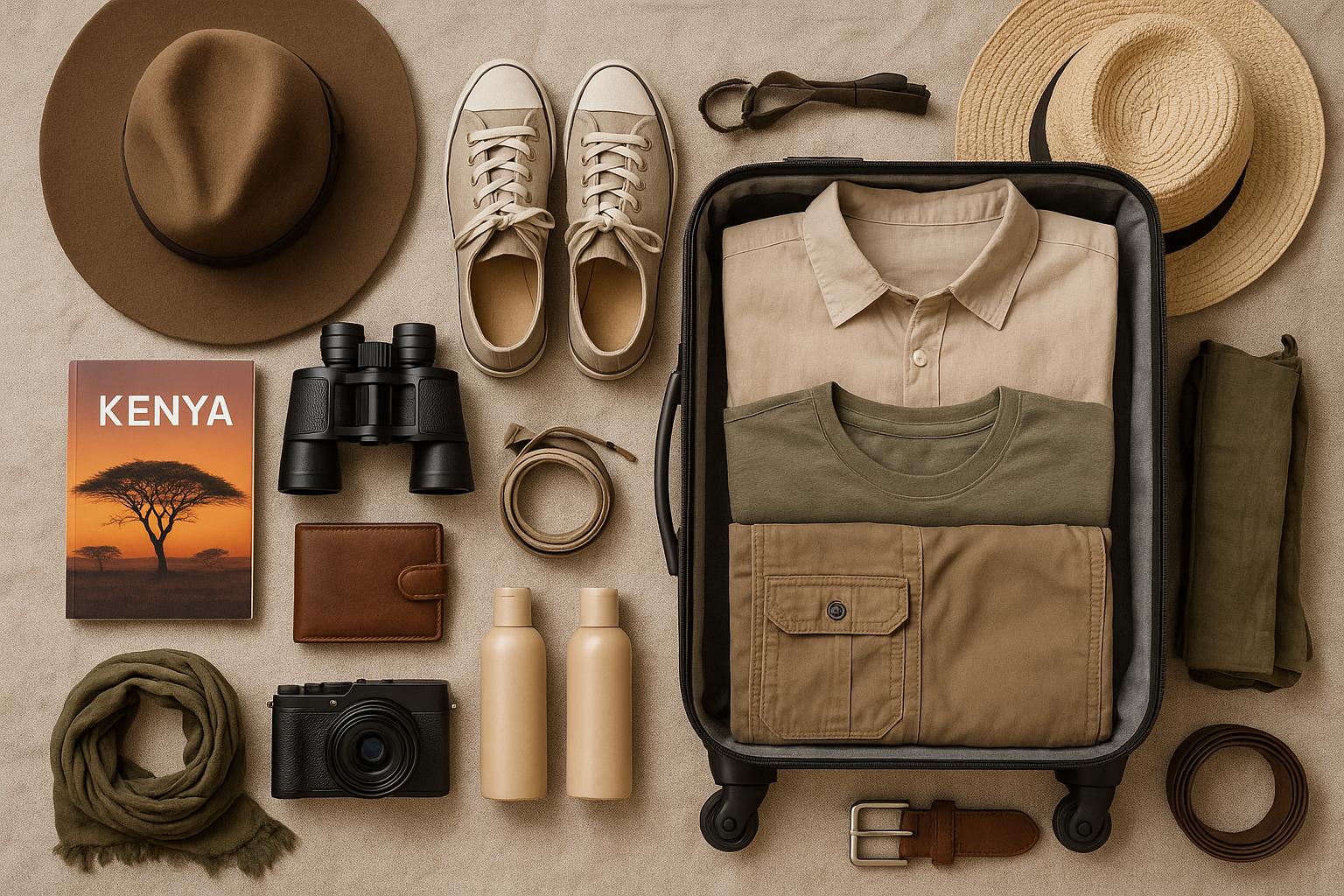

Kenya Travel Guide | Safari Tips & Packing Guide | Plush Explorer


The first time you prepare for a safari, packing can feel surprisingly complicated.
You start with a simple question:
“What should I pack?”
Then suddenly you’re searching for safari boots, binoculars, jackets, cameras, power banks, insect repellent, hats and clothes in every shade of khaki.
Before you know it, you’ve packed enough for a month.
The reality is much simpler.
You don’t need to buy an entirely new wardrobe for a Kenya safari.
You need comfortable clothes, practical shoes, protection from the sun, a few useful gadgets and enough flexibility for changing conditions.
After helping travellers plan Kenya experiences, we’ve put together this practical guide to help you pack smarter.
First: Don’t Overpack
This is probably the most important advice in this entire guide.
You don’t need to take your entire wardrobe on safari.
Most safari days follow a fairly simple rhythm:
Wake up.
Game drive.
Breakfast.
Rest.
Lunch.
Afternoon game drive.
Dinner.
Sleep.
You’re not attending formal events every evening.
Comfort matters much more than having a different outfit for every day.
A small, practical bag is usually easier to manage than several large suitcases.
1. Lightweight Clothing


Start with comfortable, lightweight clothes.
Good options include:
- T-shirts
- Polo shirts
- Lightweight trousers
- Comfortable shorts
- Long-sleeved shirts
- Light sweaters
- Casual evening clothes
You don’t need everything to be khaki.
Neutral colours such as:
Beige
Olive
Brown
Grey
White
work well and are easy to combine.
Why Long Sleeves Are Useful
A lightweight long-sleeved shirt can be one of the most useful things in your bag.
It can help protect you from:
- Sun
- Dust
- Cool mornings
- Insects
And you can roll up the sleeves when it gets warmer.
Choose breathable fabrics rather than heavy materials.
2. A Warm Layer for Early Mornings
This surprises many first-time safari travellers.
You might associate Kenya with heat.
And yes, parts of Kenya can be warm.
But early mornings in safari areas can be surprisingly cool, especially when you’re sitting in an open vehicle before sunrise.


Pack:
- Light fleece
- Hoodie
- Sweater
- Light jacket
- Windbreaker
You don’t necessarily need a heavy winter coat.
A good lightweight layer is usually enough for most travellers, depending on the season and destination.
3. Comfortable Shoes
You don’t need expensive hiking boots for a standard game-drive safari.
A comfortable pair of closed shoes is usually enough.
Consider:
- Comfortable trainers
- Walking shoes
- Lightweight hiking shoes
If you’re planning hiking or walking activities, such as Hell’s Gate or Mount Kenya, your footwear requirements may be different.


The most important thing is:
Don’t bring brand-new shoes that you’ve never worn.
The last thing you want is blisters halfway through your trip.
4. Sandals or Flip-Flops
These are useful for your accommodation.
After a long day in the safari vehicle, you may want to take your shoes off and relax.
They’re also essential if you’re combining your safari with a coastal holiday.
If your itinerary includes:
Maasai Mara + Diani
for example, sandals will get plenty of use.
5. Hat
The African sun can be strong.
A good hat is one of those simple things you’ll appreciate after several hours outdoors.


Choose something comfortable with good coverage.
A wide-brimmed hat is particularly useful.
A baseball cap works too, although it offers less protection around your neck and sides of your face.
6. Sunglasses
Bring them.
You’ll be spending a lot of time outdoors, often in open vehicles.
A good pair of sunglasses helps with:
- Bright sunlight
- Dust
- Wind
- Driving conditions
If you’re bringing expensive sunglasses, consider carrying a protective case.
7. Sunscreen
This is one of the items you don’t want to forget.
Bring a good sunscreen and apply it regularly.
Don’t forget areas people commonly overlook:
- Ears
- Neck
- Back of hands
- Face
If you’re travelling to the coast after safari, sunscreen becomes even more important.
8. Insect Repellent
Different areas have different insect conditions, so it’s sensible to carry repellent.
A good insect repellent can be particularly useful in the evenings.


Follow the product instructions and use it as recommended.
If you’re unsure about what protection you need for your specific itinerary, speak to a qualified travel-health professional before travelling.
9. Camera
Now we get to the fun part.
Kenya can be a photographer’s dream.


You don’t need a professional camera.
A good smartphone can capture incredible memories.
But if you have a camera with a telephoto lens, safari is a perfect opportunity to use it.
What Camera Lens Should You Take?
If you’re carrying interchangeable lenses, a versatile zoom lens can be extremely useful.
Wildlife doesn’t always cooperate with your preferred distance.
One minute an animal might be far away.
The next, an elephant could be much closer than expected.
A flexible zoom gives you more options.
10. Binoculars
You don’t absolutely need binoculars.
But if you have them, you’ll appreciate them.


They can help you observe:
- Birds
- Distant wildlife
- Animals across open plains
- Details you can’t easily see with the naked eye
They’re especially useful for birdwatchers.
11. Power Bank
Your phone is going to work harder than usual.
You’ll probably be:
Taking photographs.
Recording videos.
Using maps.
Checking messages.
Sharing your trip.
And perhaps listening to music during long transfers.
Bring a power bank.
It’s one of those items you don’t think about until your phone reaches 5%.
12. Charging Cables
This sounds obvious.
But it’s surprisingly easy to forget.
Before leaving home, make sure you have:
- Phone charging cable
- Camera charger
- Watch charger
- Power bank cable
- Any other essential electronics chargers
A small travel organiser can keep everything together.
13. Universal Travel Adapter
Kenya uses a different electrical socket configuration from many countries.
If you’re travelling internationally, check whether your devices need an adapter.
A universal travel adapter can be useful if you’re visiting multiple countries on the same trip.
14. Reusable Water Bottle
A reusable bottle is useful during travel and helps reduce unnecessary single-use plastic.
Many safari lodges and tour operators have systems for providing drinking water.
Check with your accommodation or tour operator about how drinking water is supplied during your trip.
And on game drives, always follow your guide’s advice about water and hydration.
15. Small Day Bag
You don’t want to carry your entire suitcase into the safari vehicle.
A small daypack is useful for:
- Water
- Camera
- Sunscreen
- Sunglasses
- Hat
- Binoculars
- Phone
- Power bank
- Light jacket
Keep it small enough that it doesn’t become a nuisance inside the vehicle.
16. A Small Flashlight
A small torch or headlamp can be useful around safari camps and lodges.
Especially if you’re staying somewhere where pathways are not brightly lit after dark.
Your phone has a flashlight too, but a dedicated headlamp leaves both hands free.
17. Personal Toiletries
Most good lodges provide basic toiletries.
But don’t assume everything will be available.
Bring the products you personally rely on.
For example:
- Toothbrush
- Toothpaste
- Deodorant
- Moisturiser
- Lip balm
- Hair products
- Personal hygiene items
Travel-sized products can save space.
18. Medication and Personal Essentials
Bring any medication you normally need in your original packaging and carry enough for the entire trip.
It’s also sensible to have essential items easily accessible rather than buried at the bottom of your luggage.
If you have specific medical or travel-health needs, speak with an appropriate healthcare professional before travelling.
19. Small First-Aid Kit
You don’t need to bring a full pharmacy.
A basic travel kit can be useful for minor issues.
Depending on your needs, this might include:
- Plasters
- Antiseptic wipes
- Basic pain relief
- Blister treatment
- Personal medication
For specific medical concerns, get professional advice before travelling.
20. A Notebook
This one isn’t essential.
But we recommend it.


Write down what you see.
The name of the first lion you encounter.
The location where you saw elephants.
The funniest thing your guide said.
The best meal you had.
The sunset you almost forgot to photograph.
Years later, those little details can become more valuable than the pictures.
What NOT to Pack
Sometimes knowing what to leave at home is more important.
Don’t bring too many clothes
You won’t need them.
Don’t bring uncomfortable shoes
Safari isn’t a fashion show.
Don’t pack extremely heavy luggage
Especially if your itinerary involves small aircraft or domestic flights.
Don’t bring unnecessary valuables
Take what you need.
Leave what you don’t.
Don’t buy expensive safari gear just for the trip
Use what you already own where possible.
Should You Wear Khaki?
This question comes up all the time.
No, you don’t have to.
Khaki is popular because it’s practical and photographs well.
But there’s no safari police checking the colour of your shirt.
Wear comfortable, breathable clothing.
If you want to avoid attracting unnecessary attention from insects, extremely bright colours may not be the most practical choice in some environments.
What About Black Clothing?
You can wear black.
But dark colours can absorb more heat in strong sunlight.
For daytime safari, lighter colours may be more comfortable.
Again, comfort matters more than following some imaginary safari dress code.
What About Bright Colours?
You don’t need to panic if you only own colourful clothes.
But if you’re buying clothes specifically for safari, neutral colours are generally more practical.
And if you’re walking in wildlife areas, follow your guide’s clothing recommendations.
What to Wear on a Game Drive
A simple outfit could be:
Morning
Light trousers + T-shirt + fleece + comfortable shoes
Midday
T-shirt + trousers/shorts + hat
Afternoon
T-shirt + light layer + comfortable shoes
Evening
Casual dinner clothes + sweater or jacket
That’s enough.
What to Wear at the Safari Lodge
Most safari lodges are relaxed.
You generally don’t need formal clothing unless the specific property has a dress code.
A clean casual outfit is usually enough.
Think:
Smart casual
rather than
Black tie.
What If You’re Combining Safari and Beach?
This is where packing gets interesting.
Let’s say your itinerary is:
Nairobi → Maasai Mara → Diani
You’ll need both safari and beach essentials.


Safari
- Lightweight trousers
- T-shirts
- Long sleeves
- Jacket
- Closed shoes
- Hat
- Sunglasses
- Camera
Beach
- Swimwear
- Sandals
- Beachwear
- Sunscreen
- Light clothing
- Sunglasses
The good news?
Most of these items are lightweight.
Safari Packing Checklist
Here’s the simple version you can save.
Clothing
☐ T-shirts
☐ Polo shirts
☐ Lightweight trousers
☐ Shorts
☐ Long-sleeved shirts
☐ Light sweater
☐ Light jacket
☐ Underwear
☐ Socks
☐ Sleepwear
Footwear
☐ Comfortable closed shoes
☐ Sandals/flip-flops
Sun Protection
☐ Hat
☐ Sunglasses
☐ Sunscreen
☐ Lip balm
Safari Gear
☐ Camera
☐ Extra memory cards
☐ Binoculars
☐ Power bank
☐ Small backpack
☐ Water bottle
Personal
☐ Toiletries
☐ Medication
☐ Small first-aid kit
☐ Insect repellent
☐ Travel documents
Electronics
☐ Phone
☐ Chargers
☐ Camera batteries
☐ Travel adapter
☐ Power bank
Documents You Should Check Before Leaving
Don’t focus so much on clothes that you forget the important documents.
Depending on your nationality and itinerary, make sure you have checked requirements for:
- Passport
- Visa or travel authorisation requirements
- Flight tickets
- Accommodation confirmations
- Travel insurance
- Safari booking confirmation
- Emergency contacts
- Copies of important documents
Entry requirements can change, so verify the current requirements before travelling.
A Note About Luggage
If you’re taking a domestic flight to a safari destination, luggage restrictions can be different from international flights.
This is particularly important when travelling on smaller aircraft.
Before packing, confirm the baggage allowance with your airline or tour operator.
Don’t assume your international airline allowance automatically applies to your domestic safari flight.
The Smartest Way to Pack
Here’s a method that works well.
Step 1
Lay everything out.
Step 2
Remove 20%.
Step 3
Remove another 10%.
Step 4
Ask:
“Will I actually use this?”
If the answer is no, leave it.
Your back will thank you.
The One Thing You Can’t Pack
There’s one thing that won’t fit into your suitcase.
Expectations.
You might go to the Mara hoping to see a leopard.
Instead, you see a family of elephants spending an hour crossing a river.
You might expect Kilimanjaro to be visible.
Instead, clouds cover the mountain and you have an incredible encounter with elephants.
You might plan the perfect photograph.
Instead, you end up talking to your guide for 30 minutes about life in the Mara.
Travel doesn’t always follow the plan.
That’s okay.
Sometimes that’s the best part.
Final Safari Packing Checklist
Before you leave home, ask yourself:
Do I have comfortable clothes?
Do I have something warm for early mornings?
Do I have comfortable shoes?
Do I have sun protection?
Do I have my medication?
Do I have my documents?
Do I have chargers?
Do I have enough storage for photographs?
Do I have a small day bag?
If the answer is yes, you’re probably ready.
You don’t need 30 outfits.
You don’t need a suitcase full of expensive safari gear.
You need to be comfortable, prepared and ready for the adventure.
And Don’t Forget the Most Important Thing
Bring curiosity.
Because you are going to see things you’ve probably never seen before.
You may hear lions calling at night.
You may watch elephants crossing the road.
You may wake up to a sunrise over the Mara.
You may sit beside the Indian Ocean a few days later.
You may meet people whose stories stay with you long after you leave Kenya.
Pack your camera.
Pack your sunscreen.
Pack something warm.
But most importantly:
Pack an open mind.
Ready for Your Kenya Safari?
At Plush Explorer, we help travellers plan experiences across Kenya and beyond.
From the first airport transfer to the final sunset, we can help you create an itinerary that fits your interests, budget and available time.
Whether you’re planning:
A Maasai Mara safari
An Amboseli adventure
A Kenya safari + beach holiday
A family trip
A honeymoon
A golf and safari experience
or a completely customised Kenya adventure, we’d love to help.
Explore Kenya with Plush Explorer
Explore Our Travel Experiences
Start Planning Your Kenya Safari
Final Thought
Your safari starts long before you see the first elephant.
It starts when you begin planning.
When you choose your destination.
When you wonder what the Mara will look like.
When you pack your camera.
When you wake up before sunrise and step outside into the cool morning air.
Then the vehicle starts moving.
The sun begins to rise.
And suddenly you’re there.
Welcome to Kenya.
Travel More. Experience More. Play More.
SEO DETAILS
SEO Title:
Kenya Safari Packing List: What to Pack for Your First Safari
URL Slug:/kenya-safari-packing-list/
Focus Keyphrase:
Kenya safari packing list
Meta Description:
Planning your first Kenya safari? Use this practical packing list covering clothing, shoes, camera gear, toiletries, documents, luggage and safari essentials.
Secondary Keywords:
- Kenya safari packing list
- what to pack for Kenya safari
- what to wear on safari in Kenya
- Kenya safari essentials
- safari clothing Kenya
- Maasai Mara packing list
- Kenya travel packing list
- first time safari tips
- Kenya safari tips
- Kenya safari travel guide
- safari holiday packing list
- Kenya safari checklist
- what to take on African safari
- Kenya safari and beach packing list
Suggested URL:https://plushexplorer.co.ke/kenya-safari-packing-list/
Suggested Category:
Safari Guides
Suggested Tags:
Kenya Safari, Safari Packing List, Maasai Mara, Amboseli, Kenya Travel, Safari Tips, Travel Guide, Kenya Holidays
Featured Image:
A realistic photograph of a traveller in a safari vehicle at sunrise, wearing practical neutral clothing, with the Kenyan savannah in the background.
Recommended internal links:
- Kenya Travel Guide
- Maasai Mara
- Amboseli
- Nairobi
- Naivasha
- Diani Beach
- Kenya Safari Packages
- Kenya Beach Holidays
- Kenya Golf Holidays
- Kenya Travel Experiences
0 Comment